CVE-2026-99312: Linux KVM Bug Lets Guests Reach Host Memory on AMD
Key points
- CVE-2026-99312 lets root inside a KVM guest read and write the host’s physical memory.
- Only AMD hosts with nested virtualization enabled are affected. Intel hosts are not.
- The fix is in the host kernel: Linux 7.3.5, 6.18.64 and 6.12.118. Updating guest systems changes nothing.
- Operators who cannot patch yet can set
kvm_amd nested=0and reboot the host.
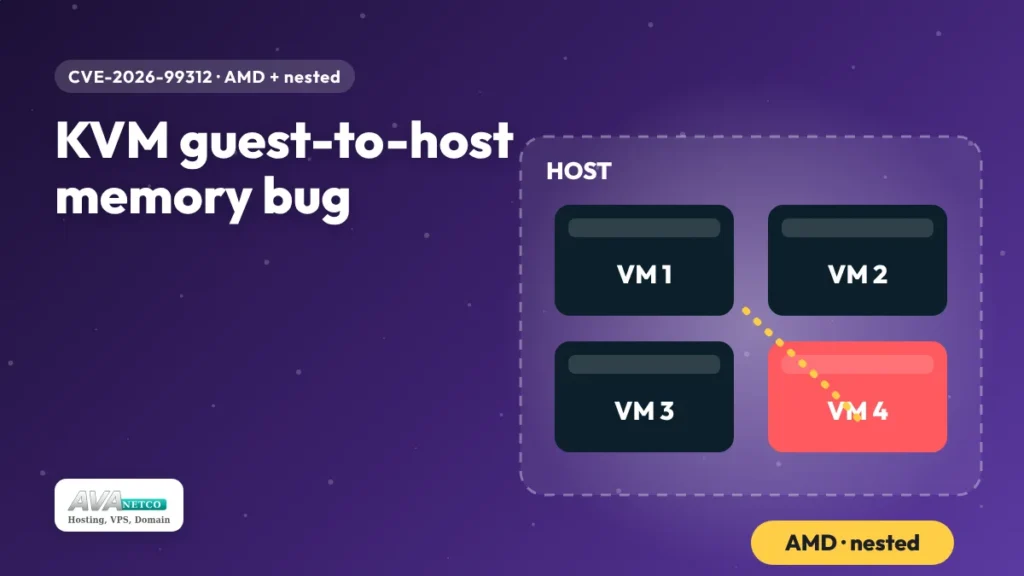
Virtualization is built on one promise: what happens inside a virtual machine stays there. CVE-2026-99312 breaks that promise on a specific but common setup. A guest with root access could read large parts of the host’s RAM and, on a test machine, write chosen bytes into a live host kernel page. On a shared host, that memory belongs to every other virtual machine as well.
What exactly goes wrong?
Nested virtualization lets a guest run virtual machines of its own. When such a nested guest is stopped with an INIT signal, KVM on AMD processors forgets to restore one pointer belonging to the outer guest: the address of its nested page table. The pointer keeps pointing at memory that has already been freed and reused. A guest that controls what lands in that memory can use it to map any physical page of the host into its own address space.
The mistake came in with a 2022 fix for an older bug (CVE-2022-3344) and stayed in the kernel for almost four years. It reached stable kernels from 6.1 and was backported as far as 5.15.81 and 6.0.11.
Who needs to act?
| You are… | What to do |
|---|---|
| Running your own KVM hosts on AMD (Proxmox, OpenStack, libvirt) | Patch the host kernel and reboot, or disable nested virtualization now. |
| Running KVM hosts on Intel | Not affected by this bug. Normal kernel updates apply. |
| A VPS customer | Nothing to install inside your server. The provider has to update the host. |
| Using nested virtualization inside a VPS | Expect it to be switched off on some hosts until they are patched. |
How do I fix a KVM host?
Check whether the host is exposed
grep -m1 -o -E 'svm|vmx' /proc/cpuinfo      # svm = AMD, vmx = Intel
cat /sys/module/kvm_amd/parameters/nested   # 1 or Y = nested enabled
uname -r
Install the fixed kernel
Upstream fixes are in 7.3.5, 6.18.64 and 6.12.118. When this was written, distribution support was mixed: some had fixes only in development branches, others had marked their stable kernels as affected with the fix still pending. Watch your distribution’s tracker for CVE-2026-99312, install the update as soon as it appears, and reboot the host. Live-migrate guests first if your platform supports it.
Turn off nested virtualization until then
echo "options kvm_amd nested=0" | sudo tee /etc/modprobe.d/kvm-amd-nested.conf
sudo reboot
cat /sys/module/kvm_amd/parameters/nested   # should now print 0 or N
Nested virtualization is enabled by default on many systems. Guests that run Docker Desktop, Android emulators, test hypervisors or Windows features based on Hyper-V will lose that capability until it is switched back on.
How serious is it?
The kernel’s own CVE team scores it 8.8. Some vendors rate it lower, treating it as a denial-of-service risk, but the published research showed reading over a hundred gigabytes of host memory and writing into a host kernel page. The attacker does need root inside a VM on the same host, which on a public cloud is simply a matter of renting one. No attacks or public exploit had been reported when the fix was announced.
What this means for a VPS
A KVM VPS runs its own kernel, and you are responsible for updating it, as described in our guide to the Linux TCP bug from October. Host-side bugs like this one are the provider’s job. If you rely on nested virtualization for your work, ask your provider whether it is currently enabled on your host. Browse our KVM VPS locations if you are planning a new server.